Diffraction Methods
Diffraction Methods
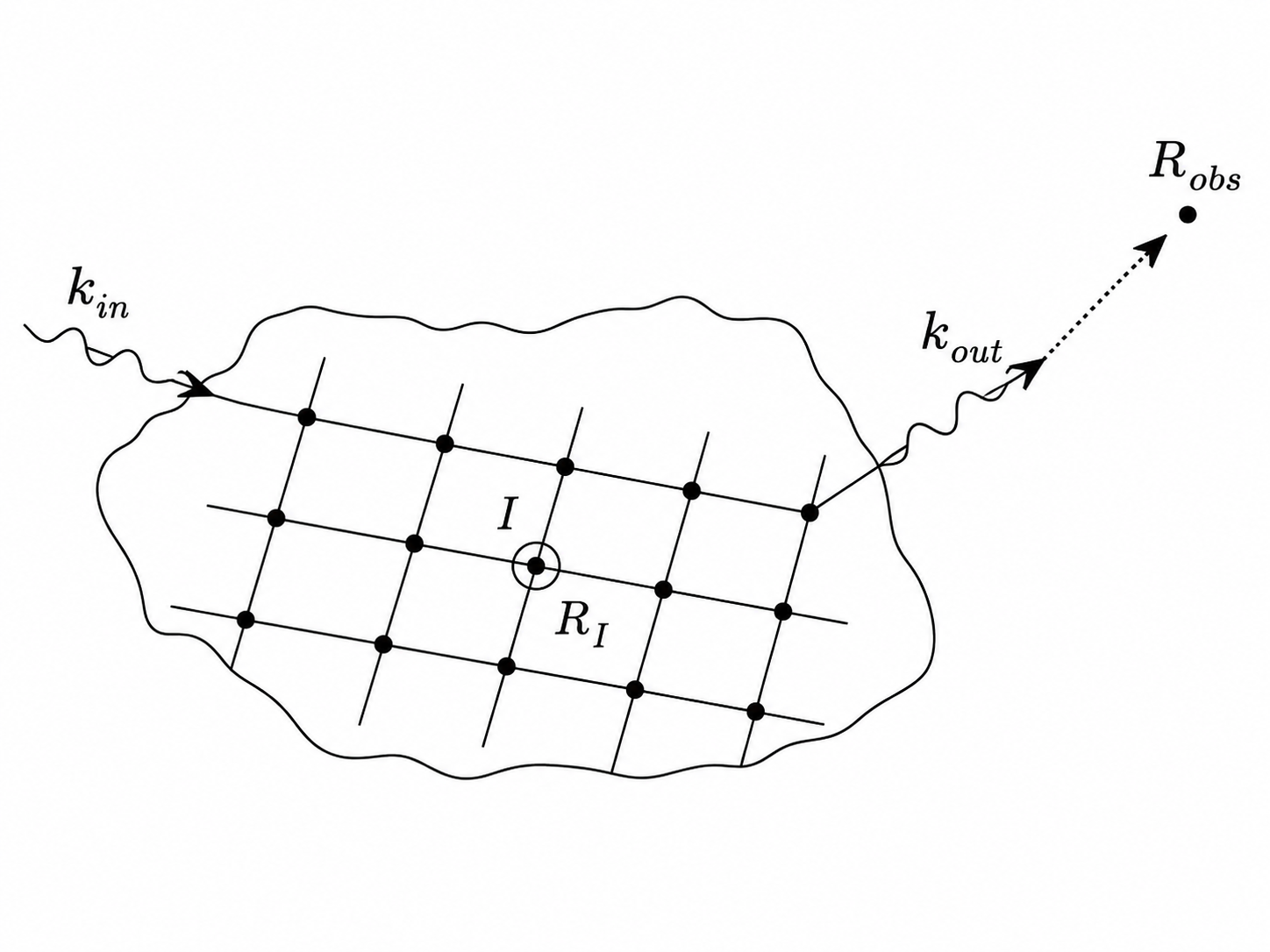
\[ k=\frac{\omega}{c}=|\vec{k}| \]
The incoming electromagnetic field is
\[ \vec{E}_{\mathrm{in}} = \vec{E}_{\mathrm{in}}^{(0)} e^{i(\vec{k}_{\mathrm{in}}\cdot \vec{r}-\omega t)} \]
This corresponds to shining light (x-ray, neutron etc.) onto the sample.
The outgoing/scattered electromagnetic field is
\[ \vec{E}_{\mathrm{out}} = \vec{E}_{\mathrm{out}}^{(0)} e^{i(\vec{k}_{\mathrm{out}}\cdot \vec{r}-\omega t)} \]
We are seeing electromagnetic radiation generated by the charge density of the sample.
Since the incoming light illuminates the atoms at the same frequency, we may say that
\[ |\vec{k}_{\mathrm{out}}| = |\vec{k}_{\mathrm{in}}| = k = \frac{\omega}{c} \]
At atom at site \(I\), the electric field due to the incoming wave is
\[ \vec{E}_{\mathrm{in}}(\vec{R}_I,t) = \vec{E}_{\mathrm{in}}^{(0)} e^{i(\vec{k}_{\mathrm{in}}\cdot \vec{R}_I-\omega t)} \]
Now what is the phase of the outgoing scattered field w.r.t to the observer position \(\vec{R}_{\mathrm{obs}}\) due to atom \(I\)?
The outgoing wave travels from atom \(I\) to the observer. Therefore, the phase acquired during propagation depends on the distance from \(\vec{R}_I\) to \(\vec{R}_{\mathrm{obs}}\).
The scattered field from atom \(I\) at the observer has a phase factor
\[ e^{i\left(k_{\mathrm{out}}(\vec{R}_{\mathrm{obs}}-\vec{R}_I)-\omega t\right)} \]
Thus, the overall phase of the electromagnetic field at the observer is:
\[ \boxed{ e^{i\vec{k}_{\mathrm{out}}\cdot (\vec{R}_{\mathrm{obs}}-\vec{R}_{\mathrm{I}})} e^{i(\vec{k}_{\mathrm{in}}\cdot\vec{R}_{\mathrm{I}}- wt)} } \]
The first factor,
\[ e^{i(\vec{k}_{\mathrm{out}}\cdot \vec{R}_{\mathrm{obs}}-\omega t)} \]
is the overall phase and is independent of the atom \(I\).
The second factor,
\[ e^{i(\vec{k}_{\mathrm{in}}-\vec{k}_{\mathrm{out}})\cdot \vec{R}_I} \]
depends explicitly on the position of atom \(I\).
And we sum over all atoms:
\[ \sum_I e^{i(\vec{k}_{\mathrm{out}}\cdot \vec{R}_{\mathrm{obs}}-\omega t)} e^{i(\vec{k}_{\mathrm{in}}-\vec{k}_{\mathrm{out}})\cdot \vec{R}_I} \]
The first factor is independent of atom \(I\), so it can be taken outside the sum:
\[ = e^{i(\vec{k}_{\mathrm{out}}\cdot \vec{R}_{\mathrm{obs}}-\omega t)} \left[ \sum_I e^{i(\vec{k}_{\mathrm{in}}-\vec{k}_{\mathrm{out}})\cdot \vec{R}_I} \right] \]
Since it is elastic scattering,
\[ |\vec{k}_{\mathrm{in}}|=|\vec{k}_{\mathrm{out}}| \]
The signal depends on the sum
\[ \sum_I e^{i(\vec{k}_{\mathrm{in}}-\vec{k}_{\mathrm{out}})\cdot \vec{R}_I} \]
If we take random values, this sum becomes essentially zero because the phases cancel:
\[ \cos \theta + i\sin \theta \]
Random phases add destructively.
Therefore, the signal is maximized when this sum is maximized.
For constructive interference, we want
\[ e^{i(\vec{k}_{\mathrm{in}}-\vec{k}_{\mathrm{out}})\cdot \vec{R}_I}=1 \qquad \forall \vec{R}_I \in \text{Bravais Lattice (B.L.)} \]
Define
\[ \vec{G}=\vec{k}_{\mathrm{in}}-\vec{k}_{\mathrm{out}} \]
Then the condition becomes
\[ e^{i\vec{G}\cdot \vec{R}_I}=1 \qquad \forall \vec{R}_I \]
So, to maximize the signal, \(\vec{G}\) must satisfy
\[ \vec{G}\cdot \vec{R}_I = 2\pi n \]
where
\[ n\in \mathbb{Z}. \]
1D Case
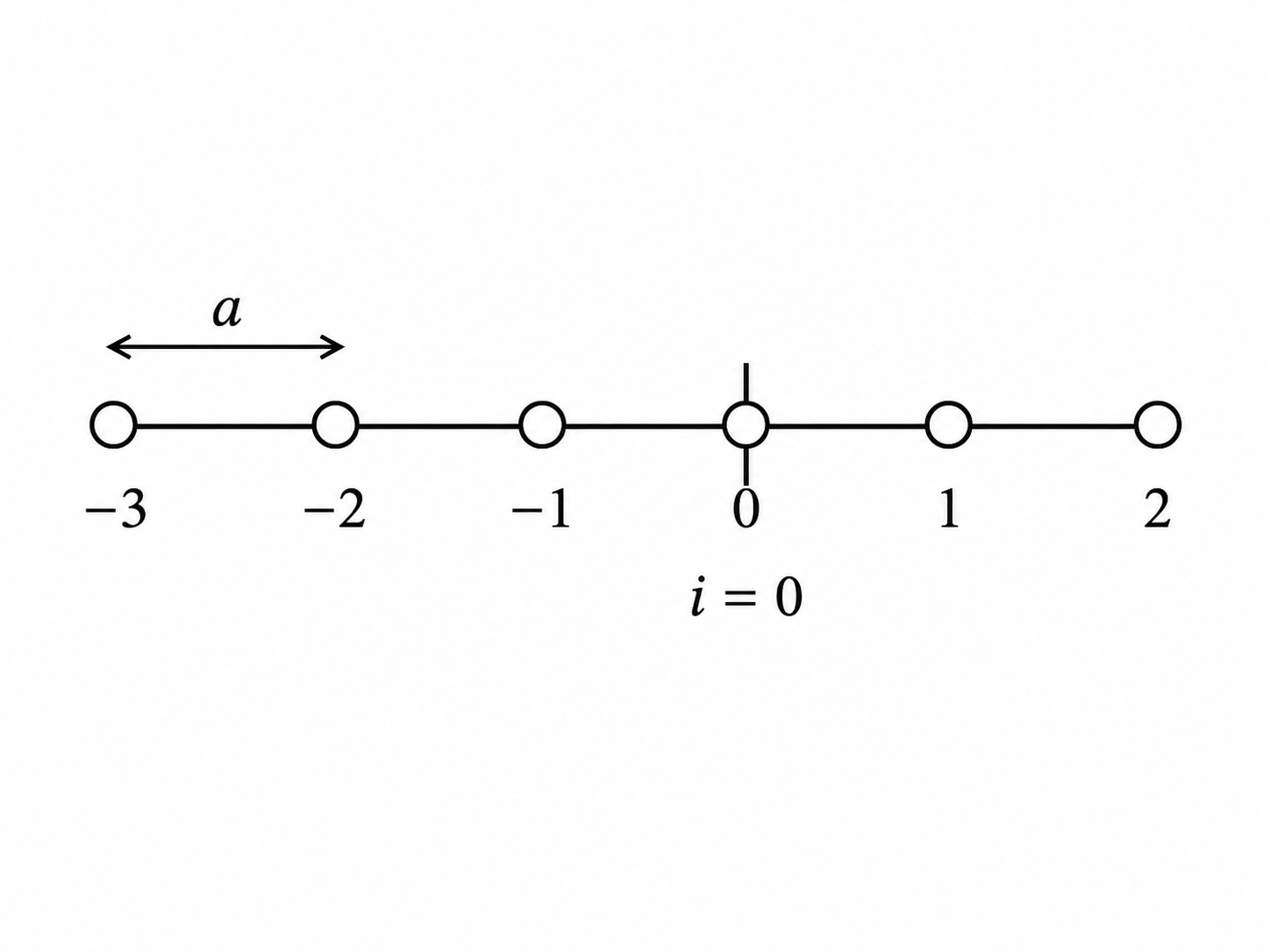
In one dimension, let us find \(\vec{G}\).
The lattice points are
\[ R_I = aI \]
where
\[ I = 0,\pm 1,\pm 2,\pm 3,\ldots \]
The constructive interference condition is
\[ e^{iG R_I}=1 \qquad \forall I \]
Substituting
\[ R_I=aI \]
gives
\[ e^{iGaI}=1 \qquad \forall I \]
This requires
\[ Ga = 2\pi n \]
Therefore,
\[ \boxed{ G=\frac{2\pi n}{a} } \]
where
\[ n\in \mathbb{Z}. \]
So the allowed reciprocal lattice vectors in 1D are
\[ G=0,\ \pm\frac{2\pi}{a},\ \pm\frac{4\pi}{a},\ \pm\frac{6\pi}{a},\ldots \]
It is possible to show that (even though I will not) when G is not one of these values, signal is essentially zero. So the signal can either be maximum or essentially zero.
The scattered intensity is proportional to the square modulus of the sum over atoms:
\[ I \propto \left| \sum_I e^{i\vec{G}\cdot \vec{R}_I} \right|^2 \]
where
\[ \vec{G}=\vec{k}_{\mathrm{in}}-\vec{k}_{\mathrm{out}}. \]
For constructive interference, we need
\[ e^{i\vec{G}\cdot \vec{R}_I}=1 \qquad \forall \vec{R}_I \in \text{Bravais lattice}. \]
In other words,
\[ \vec{G}\cdot \vec{R}_I = 2\pi m, \qquad m\in \mathbb{Z}. \]
So \(\vec{G}\) must be a reciprocal lattice vector.
Reciprocal Lattice in 3D
Suppose \(\vec{G}_1\), \(\vec{G}_2\), and \(\vec{G}_3\) satisfy the constructive interference condition.
Then any integer linear combination also satisfies it:
\[ \vec{G} = n_1\vec{G}_1+n_2\vec{G}_2+n_3\vec{G}_3 \]
where
\[ n_1,n_2,n_3\in \mathbb{Z}. \]
Therefore, there are infinitely many reciprocal lattice vectors \(\vec{G}\).
We can choose three independent vectors \(\vec{G}_1,\vec{G}_2,\vec{G}_3\) that generate all reciprocal lattice vectors.
These are the primitive reciprocal lattice vectors. The primitive reciprocal lattice vectors are
\[ \vec{G}_1 = 2\pi \frac{\vec{a}_2\times \vec{a}_3} {\Omega} \]
\[ \vec{G}_2 = 2\pi \frac{\vec{a}_3\times \vec{a}_1} {\Omega} \]
\[ \vec{G}_3 = 2\pi \frac{\vec{a}_1\times \vec{a}_2} {\Omega} \]
where
\[ \Omega = \vec{a}_1\cdot \left( \vec{a}_2\times \vec{a}_3 \right) \]
is the volume of the real-space primitive unit cell.
The reciprocal lattice basis vectors satisfy
\[ \vec{G}_i\cdot \vec{a}_j = 2\pi \delta_{ij}. \]
That means
\[ \vec{G}_1\cdot \vec{a}_1 = 2\pi, \qquad \vec{G}_1\cdot \vec{a}_2 = 0, \qquad \vec{G}_1\cdot \vec{a}_3 = 0, \]
\[ \vec{G}_2\cdot \vec{a}_1 = 0, \qquad \vec{G}_2\cdot \vec{a}_2 = 2\pi, \qquad \vec{G}_2\cdot \vec{a}_3 = 0, \]
\[ \vec{G}_3\cdot \vec{a}_1 = 0, \qquad \vec{G}_3\cdot \vec{a}_2 = 0, \qquad \vec{G}_3\cdot \vec{a}_3 = 2\pi. \]
So the reciprocal basis is constructed to satisfy
\[ \boxed{ \vec{G}_i\cdot \vec{a}_j = 2\pi \delta_{ij} } \]
If \(\vec{R}_I\) is a length in real space, then \(\vec{G}\) has units of inverse length:
\[ [\vec{R}_I]=\text{length} \]
\[ [\vec{G}] = \frac{1}{\text{length}}. \]
Therefore, \(\vec{G}\) lives in reciprocal space, and reciprocal lattice is a Bravais Lattice.
Reciprocal space is sometimes called \(k\)-space.
Reciprocal Lattice in 2D
A very popular problem asked in introductory courses is that in two dimensions how do we write reciprocal lattice vectors? We introduce two real-space primitive vectors:
\[ \vec{a}_1,\vec{a}_2. \]
Since the system is two-dimensional, we can forget about \(\vec{a}_3\).
The reciprocal lattice is also two-dimensional and is generated by two reciprocal basis vectors:
\[ \vec{G}_1,\vec{G}_2. \]
Thus, in 2D, a reciprocal lattice vector is written as
\[ \vec{G} = n_1\vec{G}_1+n_2\vec{G}_2 \]
where
\[ n_1,n_2\in \mathbb{Z}. \]
The reciprocal lattice vectors \(\vec{G}_1\) and \(\vec{G}_2\) live in reciprocal space. We introduce a ficticious third axis which is prependicular to both \(\vec{a}_1\) and \(\vec{a}_2\) and forget about \(\vec{G}_3\) so that \(\vec{G}_1\) and \(\vec{G}_2\) lives in the plane crated by \(\vec{a}_1\) and \(\vec{a}_2\).